Where the ash comes from
Every winter my parents burn oak and olive wood in the fireplace of their house near Ponte de Lima. Every spring I drive up with two buckets and a sieve. A full winter gives us about eight kilos of ash, which is enough glaze for roughly four batches.
Washing
Raw ash is caustic and stings your hands. So the first job is washing it. I soak it in a big bucket of water, stir, let it settle overnight, and pour off the water. I do this five or six times over two weeks, until the water comes off clear and doesn't feel slippery between my fingers. Then it dries in the sun on old bedsheets.
Sieving
Dry ash goes through an 80-mesh sieve to take out charcoal and grit. What's left is a soft grey powder, like very fine flour. This is the slow part, and the part I save podcasts for.
The recipe
Our Ash White is roughly 40% wood ash, 40% feldspar and 20% kaolin. Every winter's ash is a little different (more olive wood one year, more oak the next), so I test each new lot on small tiles before it goes anywhere near a cup.
What the ash does in the kiln
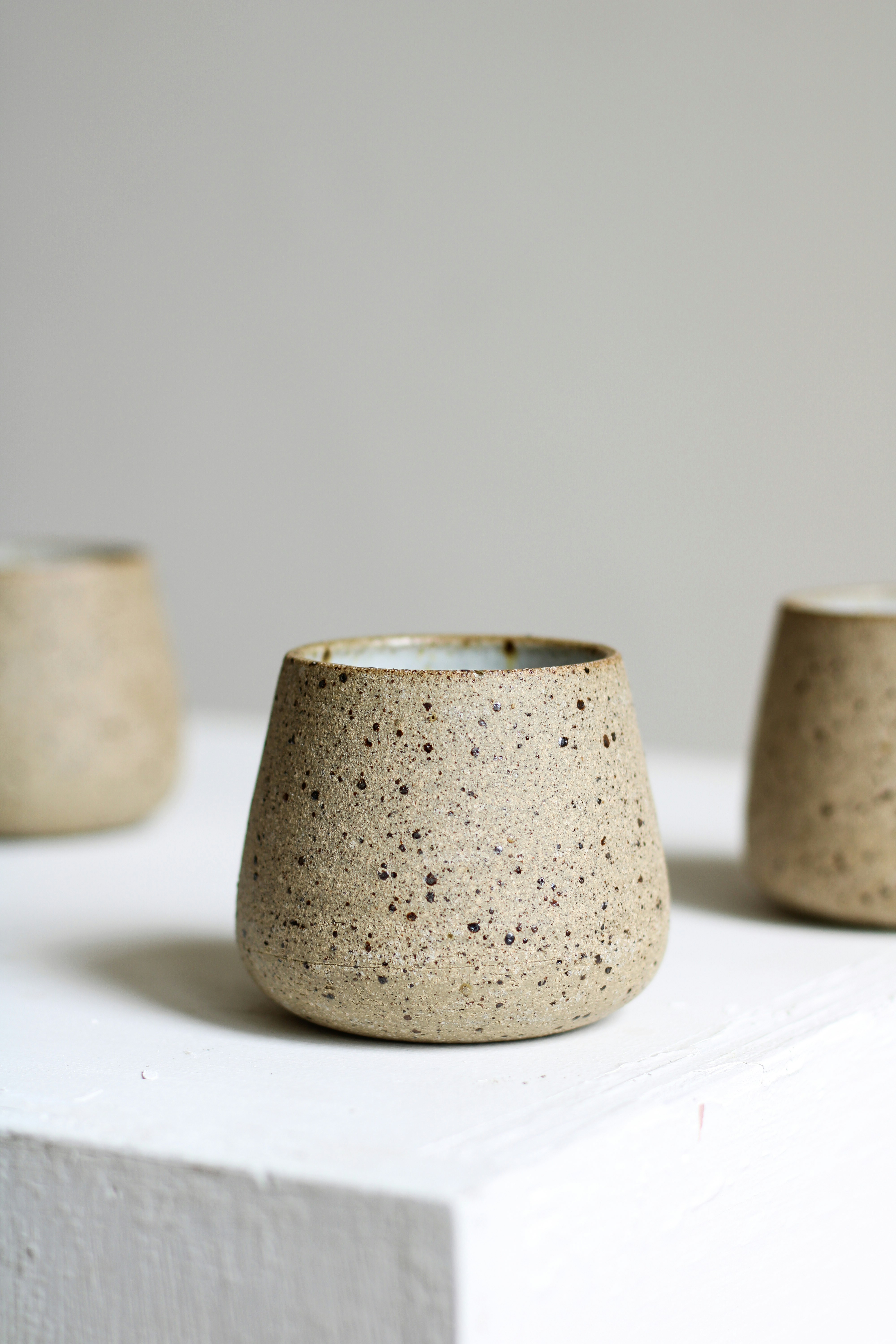
At around 1,250 °C the ash melts and starts to move. Where it's thin, it breaks over the throwing lines and lets the speckles in the clay show through. Where it's thick, it runs and pools into pale green glass. That movement is why no two Ledra cups match exactly, and it's the reason we chose this glaze in the first place.
Is it safe?
Yes. Every new mix goes to a lab in Aveiro for a leach test before it touches anything you'll eat or drink from. None has failed yet. The results are available on request.